Let’s be honest – if you’ve typed anything into ChatGPT, asked an AI to create an image, or watched machine-generated content go viral on social media, you’ve already bumped into generative AI.
But what is generative AI, exactly? And why is every business from Dubai to San Francisco suddenly talking about it?
This guide breaks it all down – no jargon overload, no fluff. Whether you’re a business leader exploring AI adoption or just trying to understand the buzz, you’re in the right place.
What is Generative AI?
So, what is generative AI? In the simplest terms, it’s a type of artificial intelligence that doesn’t just analyze data—it creates new content from it. Text, images, audio, video, code — generative AI can produce all of it, often in seconds, and often in a way that’s genuinely difficult to distinguish from human output.
It’s the engine behind the AI tools you’re probably already using. And in 2026, it’s no longer experimental. From banks in Saudi Arabia to healthcare providers in the UAE, businesses across the GCC are rapidly integrating AI into daily operations.
Definition of Generative AI
Generative AI refers to AI systems that generate new content using machine learning models trained on large datasets. These systems can write articles, generate images, create videos, produce code, and answer questions naturally.
The key difference between traditional AI and generative AI comes down to direction:
| Traditional AI | Generative AI | |
|---|---|---|
| Core function | Detects patterns, classifies data | Creates new content |
| Primary focus | Predictions and analysis | Generation and creation |
| Typical use | Analytics, forecasting | Writing, images, code |
| Real example | Fraud detection model | ChatGPT writing content |
Traditional AI reads the room. Generative AI writes the script.
Why Generative AI is Important in 2026
We’re not at the “interesting technology” stage anymore. Generative AI has crossed into full-scale business adoption, and the numbers back that up.
Here’s why it matters right now:
- Automation and productivity — tasks that used to take hours (drafting reports, writing code, generating marketing content) now take minutes. That’s not a small efficiency gain; it’s a structural shift in how work gets done.
- Industry-wide transformation — from healthcare to banking to oil and gas, generative AI is reducing costs, improving decision-making, and delivering better customer experiences.
- Competitive pressure — businesses that adopt AI tools thoughtfully are building a genuine advantage. Those that don’t are starting to feel the gap.
Saudi Arabia’s Vision 2030 and the UAE AI Strategy are accelerating adoption across sectors, including finance, healthcare, logistics, and government services. To understand how this is reshaping the region, read our in-depth piece on how generative AI is reshaping the Gulf’s digital economy. The question in 2026 isn’t whether generative AI is relevant to your business. It’s how quickly you can put it to work.
How Does Generative AI Work?
You don’t need a computer science degree to grasp this. Here’s a clear explanation of how generative AI works under the hood.
Machine Learning and Large Language Models (LLMs)
Generative AI is built on machine learning—the process of training a model by feeding it enormous amounts of data (text, images, videos, and code) and letting it find patterns.
Large Language Models (LLMs) are a specific type of AI trained on vast datasets: books, websites, academic papers, code repositories, and more. During training, the model learns the statistical relationships between words, sentences, and ideas. When you ask it a question, it draws on those learned patterns to generate a response that makes sense in context.
It’s not “understanding” language the way you do — but the output can be remarkably coherent, creative, and useful.
Key Technologies Behind Generative AI
Three technologies sit at the core of modern generative AI systems:
Natural Language Processing (NLP) is what allows AI to read, interpret, and generate human language. It’s the reason you can type a question in plain English and get a sensible answer back.
Deep Learning is the broader machine learning framework — multi-layered neural networks that process data in a way loosely inspired by the human brain. The more layers, the more complex the patterns the model can recognise and replicate.
Transformers are the architectural breakthrough that made modern AI possible. Introduced in 2017, the transformer model processes entire sequences of data simultaneously rather than word by word — which made training on internet-scale datasets feasible. GPT (Generative Pre-trained Transformer) is named after this architecture, and it powers ChatGPT, Gemini, Claude, and most other leading models today.
Popular Generative AI Models
Several major models are leading the generative AI landscape in 2026:
- ChatGPT (OpenAI) — the model that brought generative AI to the mainstream; widely used for writing, research, customer service, and coding.
- Gemini (Google DeepMind) — Google’s multimodal AI, capable of processing text, images, audio, and video in combination.
- Claude (Anthropic) — known for strong reasoning, nuanced long-form writing, and a focus on safe, helpful AI behaviour.
- Midjourney — the leading AI image generation platform, used by designers, marketers, and creatives worldwide.
If you’re interested in building a career around these tools, our Generative AI Career Guide covers the skills, certifications, and roadmap you need.
Top Generative AI Examples in Real Life
Enough theory. Let’s look at generative AI examples you can actually see and use today.
AI Chatbots and Virtual Assistants
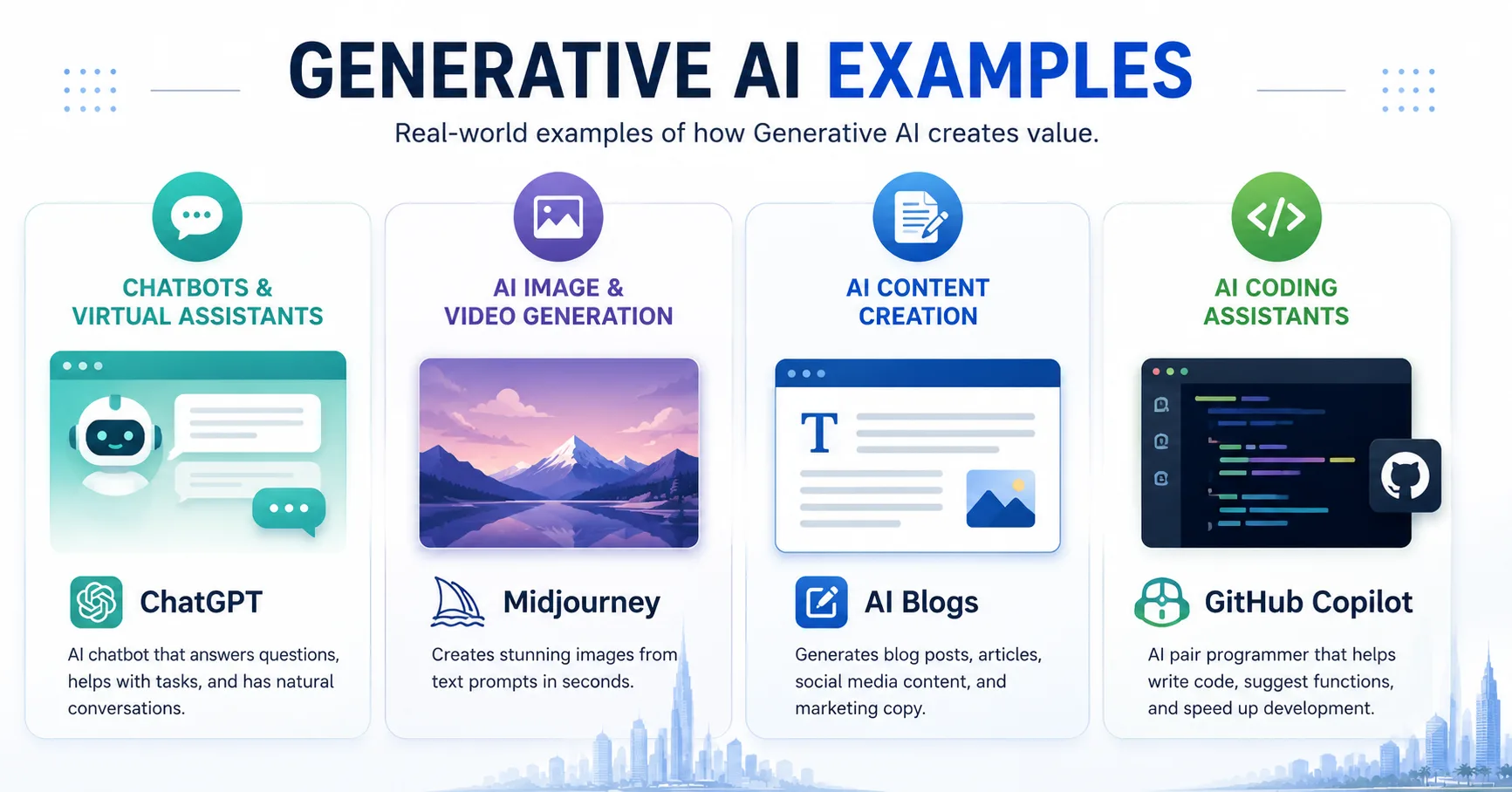
ChatGPT is the obvious one — over 200 million people use it weekly. But the real business impact comes from custom AI chatbots built on top of these models. Companies are deploying AI assistants for customer support that handle complex queries, escalate where needed, and do so 24/7 without burnout or sick days. ChatGPT-style systems are already reducing response times significantly across GCC businesses.
AI Image and Video Generation
Tools like Midjourney and DALL·E (OpenAI) can generate photorealistic images, stylised artwork, and branded visuals from text descriptions in seconds. Sora, OpenAI’s video generation model, produces short, high-quality video clips from text prompts — a development that’s already shaking up advertising, content production, and film pre-visualisation. Marketing agencies in Dubai and Riyadh are integrating AI-generated creative assets into campaigns right now.
AI Content Creation Tools
Blog posts, social media captions, product descriptions, email sequences — AI writing tools can produce drafts of all of these at scale. This doesn’t mean replacing human writers; it means giving them a strong first draft instead of a blank page, which meaningfully accelerates the creative process. Understanding data science vs data analytics can help businesses decide which AI-driven capabilities to prioritise for content and strategy.
AI Coding Assistants
GitHub Copilot has become a standard tool for software developers. It autocompletes code, suggests functions, flags bugs, and explains what existing code does. Developers using AI coding assistants consistently report 30–55% faster completion on routine tasks — a productivity gain that compounds quickly across an engineering team.
Generative AI Use Cases Across Industries
Here’s where things get practical. The generative AI use cases below are happening right now, in real organisations, at real scale.
Generative AI in Healthcare
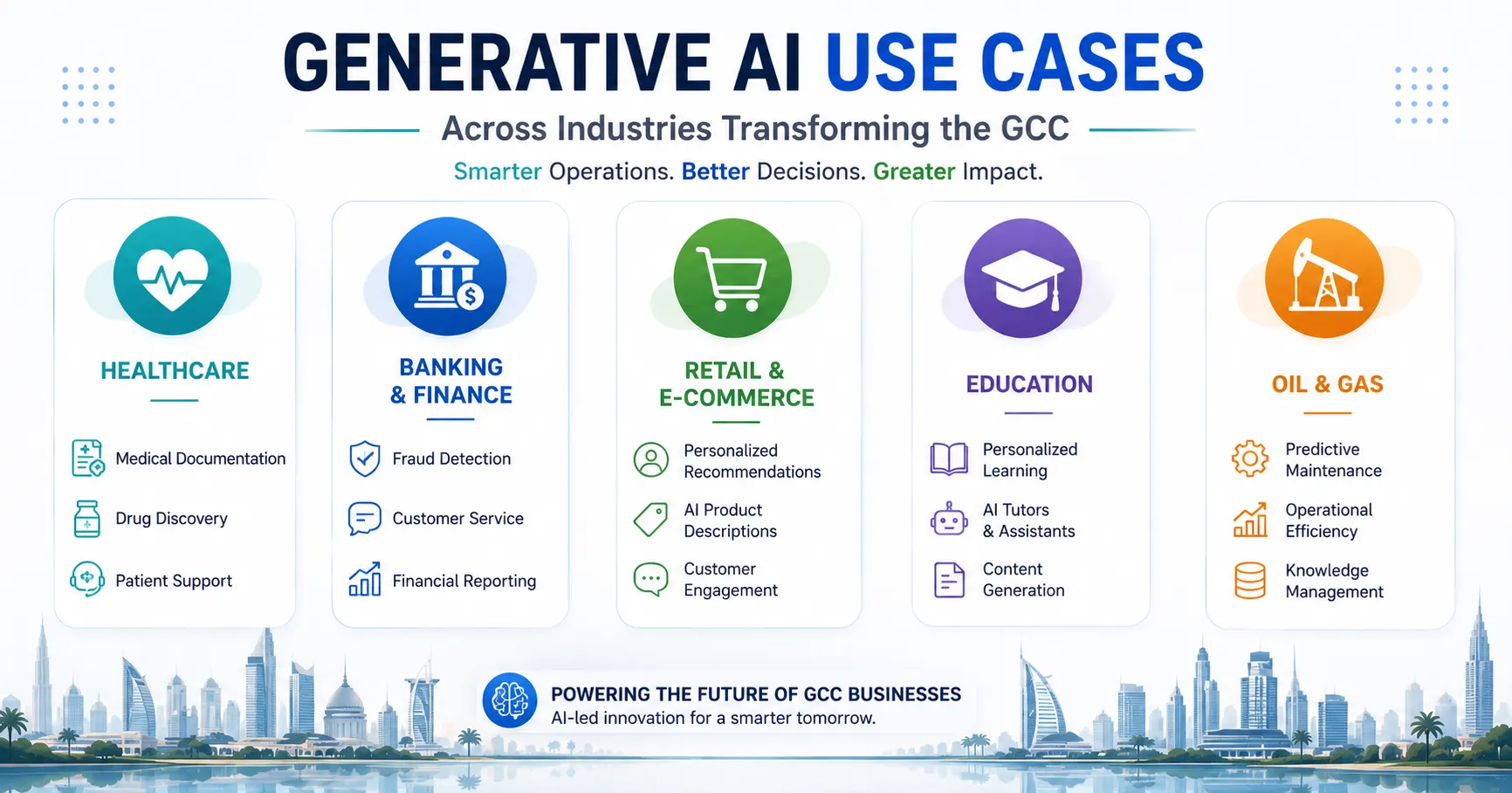
Medical documentation alone is one of the most compelling use cases. Physicians in many countries spend nearly as much time on paperwork as they do with patients. Generative AI tools can transcribe consultations, draft clinical notes, and generate discharge summaries — giving doctors more time for actual care.
In drug discovery, AI models analyse molecular structures, predict how compounds will interact with biological systems, and accelerate the identification of drug candidates. What once took years in a lab can be narrowed down in weeks with AI assistance. Read more in our detailed piece on data science in healthcare and how it’s transforming the Middle East.
Generative AI in Banking and Finance
Banks in Saudi Arabia and the UAE are using AI for fraud detection, customer service automation, and financial reporting. Fraud detection models analyse transaction patterns in real time and flag anomalies far faster than any human team. Generative AI adds a layer on top — generating natural language explanations of flagged transactions, which helps compliance teams act quickly.
For financial reporting, AI tools generate draft analyst reports, earnings summaries, and regulatory filings from structured data, which teams then review and approve. The opportunities are significant—explore how AI is transforming the Saudi Arabia financial sector and how AI is being applied in Islamic finance across the region.
Generative AI in Banking in Bahrain
Bahrain’s banking sector deserves a specific mention. Local financial institutions are actively piloting generative AI for customer onboarding, credit decisioning, and compliance automation. Our in-depth look at how generative AI is transforming banking in Bahrain covers what’s already live and what’s on the horizon.
Generative AI in Retail and E-commerce
Personalised product recommendations driven by AI have become table stakes in e-commerce. Generative AI takes this further—creating personalised product descriptions, tailored promotional emails, and dynamic landing pages based on browsing behavior and purchase history. Customer engagement tools handle product queries, returns, and size recommendations, improving conversion rates while keeping operational costs in check.
Generative AI in Education
AI tutors can adapt to a student’s pace, explain concepts in different ways, and provide instant feedback — something a single teacher in a class of thirty simply can’t do consistently. Platforms using generative AI are enabling truly personalised learning paths at scale. For anyone looking to build their own AI skills from the ground up, our data science course for beginners in the GCC is a practical starting point.
Generative AI in Oil & Gas (GCC-Relevant)
This is particularly relevant for the GCC market. The energy sector generates enormous volumes of operational data—sensor readings, maintenance logs, inspection reports, geological surveys—and generative AI is being used to make sense of it.
Predictive maintenance applications forecast equipment failures before they happen, reducing unplanned downtime. Knowledge management systems built on generative AI make decades of institutional knowledge searchable and actionable — especially valuable in large upstream operations where experienced engineers are retiring, and knowledge transfer is a genuine challenge.
Applications of Generative AI in Business
Beyond specific industries, the applications of generative AI cut across business functions. Here’s where the impact is most tangible.
Marketing and Content Creation
Marketing teams are using generative AI to scale content production without scaling headcount. Blog posts, ad copy, email campaigns, social content, and video scripts — all can be drafted by AI and refined by human editors. The key is maintaining brand voice and editorial standards, which requires human oversight rather than wholesale automation.
Customer Service Automation
AI-powered support tools now handle tier-one queries across chat, email, and voice channels. The best implementations use AI to handle routine questions instantly and route complex issues to human agents with full context already prepared. This reduces wait times, improves first-contact resolution, and frees up human agents for conversations where empathy and judgment matter most.
Business Process Automation
Generative AI is being embedded into business workflows to automate document processing, report generation, data summarisation, and internal communications. Tasks that required a human to read, interpret, and write — not just click a button — are increasingly being handled by AI.
Software Development and Coding
AI coding assistants accelerate development cycles, reduce debugging time, and make it easier for developers to work across new languages and frameworks. The future of web development in Saudi Arabia is increasingly shaped by AI-assisted development—worth reading if you’re building or hiring a tech team in the region.
Data Analysis and Reporting
Generative AI can interpret structured data and generate plain-English summaries, dashboards, and reports. Business intelligence teams are turning data outputs into executive-ready narratives without manual write-ups. See which top data science tools GCC companies are using in 2026 to enable this kind of intelligence at scale.
Benefits of Generative AI
Let’s be direct about what you actually gain from adopting generative AI thoughtfully.
Increased Productivity
The most consistent benefit reported by organizations using generative AI is productivity. When routine cognitive tasks—drafting, summarising, researching, formatting—are handled by AI, people have more time for the work that requires human creativity, judgement, and relationship-building.
Faster Content Creation
Generative AI compresses the content creation cycle dramatically. A blog post that takes a skilled writer four hours to research and draft can have a solid first draft in twenty minutes with AI assistance. That’s not about replacing the writer — it’s about letting them focus on quality rather than starting from nothing.
Improved Customer Experience
Customers increasingly expect fast, personalized, 24/7 service. Generative AI makes this possible at scale. Whether it’s an AI chatbot resolving a query at 2 am or a recommendation engine surfacing exactly the right product, AI-powered experiences are raising the bar on what customers expect.
Cost Reduction and Efficiency
Automating tasks with AI reduces the cost per output across a wide range of business functions. Customer service, content production, software development, and data analysis—in each of these areas, AI tools allow organizations to do more with the same resources or maintain output while meaningfully reducing costs.
Better Decision-Making
When AI handles the grunt work of data analysis and reporting, human decision-makers get cleaner information, faster. Generative AI can surface patterns, flag anomalies, and generate scenario analyses that support better-informed decisions. Building this capability in-house starts with the right training — our Data Science with Python certification is designed for professionals who want to work directly with AI and data tools.
Challenges and Risks of Generative AI
No honest overview of generative AI leaves this part out. The risks are real, and managing them well is part of what separates successful AI adoption from costly missteps.
Data Privacy and Security
Generative AI models are trained on data, and in enterprise settings, using AI tools means data goes somewhere. Understanding where your data goes, how it’s stored, and whether it’s used to train future models is a non-negotiable first step. Many enterprise deployments now use private model instances precisely to address this. Our overview of cybersecurity job opportunities in the GCC gives useful context on the broader security landscape businesses are navigating.
AI Bias and Accuracy Issues
Generative AI can produce confident-sounding output that is factually wrong—sometimes called “hallucination.” It can also reflect biases present in its training data. Both issues require human review, particularly in high-stakes domains like healthcare, legal, and finance.
Copyright and Ethical Concerns
Questions around intellectual property—who owns AI-generated content and what happens when AI outputs closely resemble existing copyrighted work—remain unsettled in most jurisdictions. Organisations deploying generative AI need clear policies and are wise to stay close to evolving legal guidance.
Human Oversight Requirements
Generative AI is a tool, not a replacement for human judgment. The organizations getting the most from AI aren’t the ones who’ve handed everything over to the machine—they’re the ones who’ve built thoughtful workflows where AI handles the repetitive and the routine, and humans handle the complex, the sensitive, and the consequential.
Future of Generative AI in the GCC
If you’re operating in the Gulf region, the generative AI landscape is particularly worth watching.
AI Adoption in the UAE and Saudi Arabia
The UAE and Saudi Arabia are not passive observers in the global AI race — they’re active participants with significant government investment and national strategy behind AI adoption. The UAE’s national AI strategy targets AI contributing 14% of GDP by 2031. Saudi Arabia’s investments through SDAIA (Saudi Data and AI Authority) are accelerating both adoption and local capability development. The GCC is investing billions into AI infrastructure and positioning itself as a global AI leader.
Generative AI and Saudi Vision 2030
Vision 2030 has economic diversification at its core, and AI is a central enabler. From smart city development in NEOM to AI-powered public services to productivity improvements in the energy sector, generative AI tools are being embedded across Vision 2030 initiatives. The top trends shaping Saudi Arabia’s job market in 2025–26 show exactly how AI skills are becoming central to workforce planning across the Kingdom.
Opportunities for Businesses in GCC
For businesses in the GCC, the opportunity is significant — and so is the window. Companies that build genuine AI capability now will be well-positioned as regional AI ecosystems mature. Early movers gain a competitive advantage, operational efficiency, and faster innovation cycles. Whether you need IT consulting services to shape your AI strategy or corporate training programmes to upskill your team, the infrastructure to get started is right here.
How Businesses Can Start Using Generative AI
Practical steps matter more than grand strategy. Here’s a grounded approach to getting started.
Identify Business Use Cases
Start with your own operations. Where are the bottlenecks? Where is time being spent on repetitive, document-heavy, or data-intensive work? The best AI use cases aren’t theoretical — they’re the tasks your team already finds tedious and time-consuming. Common starting points include customer support, content generation, and reporting automation.
Choose the Right AI Tools
The AI tools market is crowded and moves fast. Rather than chasing the newest thing, focus on tools that integrate with your existing systems, have a credible vendor behind them, and offer clear enterprise-grade privacy and security commitments. Pilot with a small team before committing at scale.
Train Employees on AI Adoption
Technology without capability is just expense. Employees need to understand how to use AI tools effectively, how to evaluate AI outputs critically, and how to integrate AI into their workflows in ways that genuinely help. Our guide on how to become a data scientist in 2026 is a practical resource for professionals who want to build meaningful AI skills — not just surface-level familiarity. For those who want to go deeper on the AI side specifically, our Generative AI for Finance and Generative AI in Sales courses are designed for working professionals in the GCC.
Work with AI Consulting Partners
For organisations without deep internal AI capability, working with an experienced partner can save significant time and cost. A good partner brings both technical knowledge and practical implementation experience to help you avoid common pitfalls and get to value faster. Explore our IT consulting services and IT staffing solutions tailored to organisations across the GCC.
Conclusion
Generative AI is not a passing trend. It’s a foundational shift in how businesses create, communicate, analyse, and operate — and in 2026, that shift is accelerating.
From AI chatbots and content creation tools to industry-specific applications in healthcare, finance, and energy, the use cases are real, the benefits are measurable, and the barriers to entry have never been lower. For businesses in the GCC, the timing aligns with broader regional ambitions around digital transformation and economic diversification.
The businesses that will benefit most aren’t the ones who adopt AI blindly or ignore it entirely. They’re the ones who approach it thoughtfully: identifying the right use cases, building internal capability, maintaining human oversight, and working with partners who understand both the technology and the business context.
The companies that learn, adapt, and integrate AI responsibly today will lead tomorrow’s economy.
Frequently Asked Questions About Generative AI
What is generative AI in simple terms?
Generative AI is a type of artificial intelligence that creates new content — such as text, images, videos, and code — using machine learning models trained on large datasets. Unlike traditional AI that analyses or classifies information, generative AI produces original output from a given prompt or instruction.
What are some examples of generative AI?
Common examples include ChatGPT (text generation), Midjourney and DALL·E (image generation), GitHub Copilot (code generation), and Sora (video generation). These tools are used across marketing, customer service, software development, healthcare, and many other industries.
How does generative AI work?
Generative AI uses machine learning models — particularly transformer-based neural networks — trained on large datasets to identify patterns and generate human-like outputs. Large Language Models (LLMs) like ChatGPT predict the most contextually appropriate next word in a sequence, producing responses that feel natural and coherent.
What industries use generative AI?
Healthcare, banking and finance, retail, education, oil and gas, and marketing are among the industries rapidly adopting generative AI. In the GCC specifically, the energy, finance, and government sectors are seeing accelerating adoption driven by national AI strategies.
Is ChatGPT an example of generative AI?
Yes. ChatGPT is one of the most widely used examples of generative AI in the world. It is built on GPT (Generative Pre-trained Transformer) large language models developed by OpenAI and can generate text, answer questions, write code, summarize documents, and much more based on natural language prompts.